Shine, Jesus, Shine …

I can remember, way back in 1978, a rather young looking, and relatively unknown Graham Kendrick coming to Warwick University at the invitation of the Christian Union. (I’ve still got the LP I bought somewhere or other.) A few years later Christians were singing the songs he wrote all across the land, the most famous of which was (and probably still is) Shine, Jesus, Shine. It’s fair to say that for many of us it’s past it’s ‘Sing By’ date, but the words retain their relevance, and especially for our purposes now the line, Send forth your word, Lord, and let there be light.

The OT prophet Isaiah spoke about the power of God’s Word to get things done in our  Advent verse for today:
As the rain and the snow come down from heaven, and do not return to it without watering the earth and making it bud and flourish, so that it yields seed for the sower and bread for the eater, so is my word that goes out from my mouth: It will not return to me empty, but will accomplish what I desire and achieve the purpose for which I sent it.

The apostle Paul when writing to the church at Corinth reflected on the power of the word of God at creation and re-creation
For God, who said, “Let light shine out of darkness,” made his light shine in our hearts to give us the light of the knowledge of God’s glory displayed in the face of Christ. (2 Corinthians 4:6)

Isaiah had in mind the power of God’s word to bring people to repentance, trusting in the grace and mercy of God.

I’m using that line from Shine, Jesus, Shine to pray for those who were (and are) on my ‘Your Kingdom come’ list. Why not do the same?
Prayer: Gracious Lord, we pray that you would send forth your word and cause light to shine in the hearts of … Amen
I want to know Christ

“You study the Scriptures diligently,” said Jesus, “because you think that in them you have eternal life. These are the very Scriptures that testify about me, yet you refuse to come to me to have life.” (John 5:39-40)

YouTube version:

This is really what it’s all about. The Bible is a God-given means to an end and that end is to know Jesus and so have Life. The Scriptures are written in order to lead us to Jesus. Our faith is a relational faith, we are called into fellowship with God in Christ Jesus in, through and by his Spirit. Being a Christian is not just what you believe or know about Jesus (though it is important to get that right), it’s about knowing Jesus as a person. It’s not so much what you know, as who you know.

I suspect that there wasn’t much that the apostle Paul didn’t know about Jesus. His friend and travelling companion, Dr. Luke, was researching material for his gospel and I can imagine them discussing the details of what Jesus said and did together. But what was far more important to Paul was that he knew the Jesus he knew a lot about: “I want to know Christ” he declared in his letter to the church in Philippi (3:10).

Following his resurrection Jesus made it clear to his disciples that the Scriptures were about him. On the road to Emmaus Jesus “explained to them what was said in all the Scriptures concerning himself” (Luke 24:27), and then in the locked upper room he said it again to his startled disciples as “he opened their minds so they could understand the Scriptures” and all that those Scriptures said about him. (24:44,45).

But let’s be sure of this: You can’t take shortcuts. You can’t by-pass the Scriptures if you are going to know Jesus. To neglect your Bible will impoverish your relationship with him.

Some years ago (1991 to be exact) in the midst of a particularly difficult, challenging and painful period in church life and ministry, I took myself off on a day’s quiet retreat (somewhere just south of Lampeter in mid-Wales) and I spent the day prayerfully reading Psalm 119. As I sought his presence through his Word I ended the day knowing my God better than at its start. Through his word he spoke powerfully into my life and renewed my experience of him.
Will you factor in quality time in the run up to Christmas, over Christmas, into the New Year, or whenever works best for you, to know Jesus better? Delight yourself in his Word and he will come to you. To bless.

Prayer: Heavenly Father, thank you for your Son, our Saviour, Jesus. Forgive us whenever we have neglected our Bibles and allowed our relationship with you to go off the boil. Keep us from mere head knowledge, but as we turn again to the Word of Life, may we be drawn closer to Jesus and so know him better. Amen.

My theological education began early!

Yep, it’s also on YouTube https://youtu.be/ZccixhG8GEE

… and how from childhood you have known the Holy Scriptures, which are able to make you wise for salvation through faith in Christ Jesus. All Scripture is God-breathed and is useful for teaching, rebuking, correcting and training in righteousness, (2 Timothy 3:15-16)

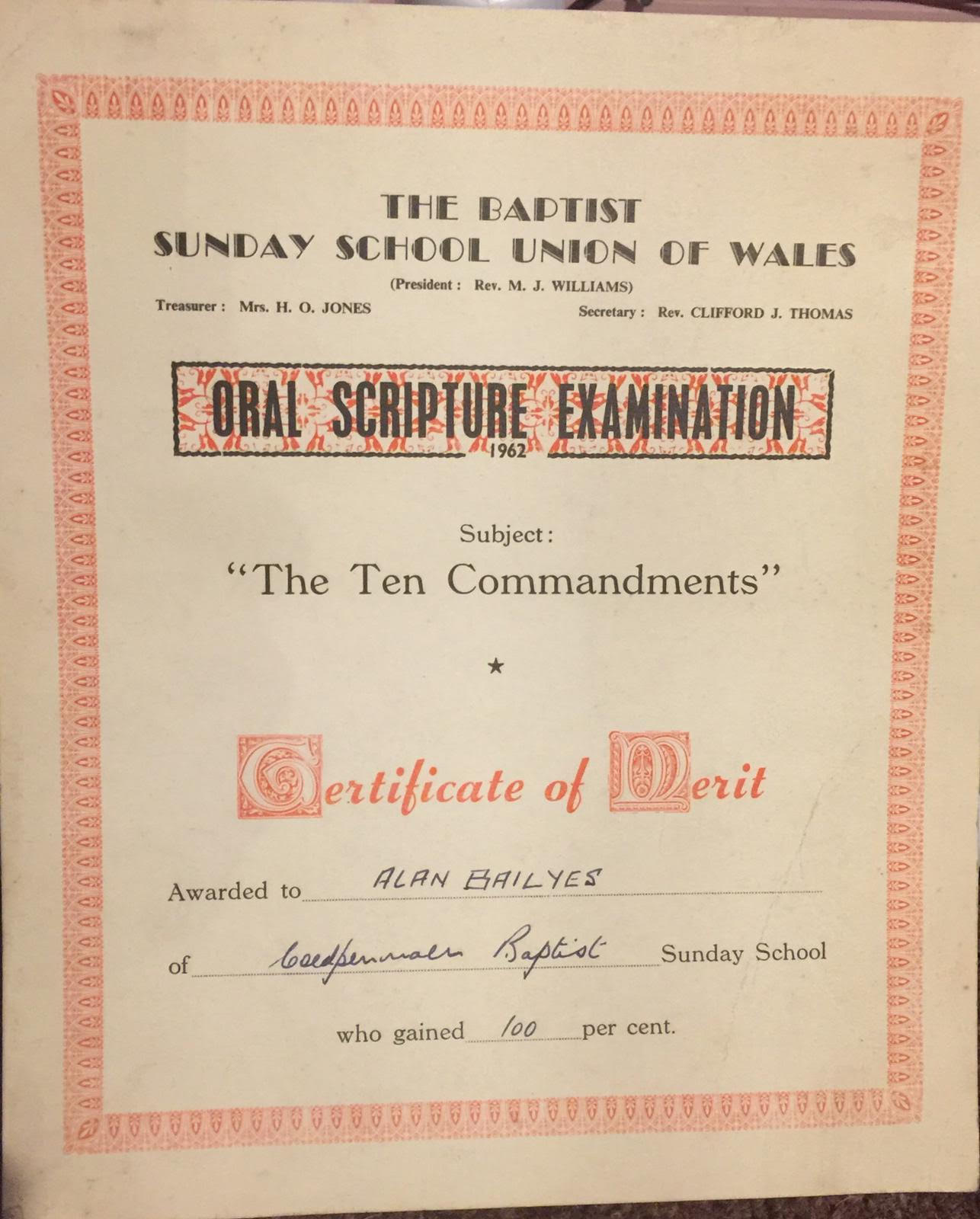
Every so often my brother sends me a picture of something that he’s come across in my parent’s home where I was born and brought up. These have included diary entries from family holidays in Weston-super-Mare! But the most recent was a photo of a certificate that I was awarded when I was just 4 years old. It’s headed ‘The Baptist Sunday School Union of Wales’; the subject was ‘The Ten Commandments’ and I gained 100% in an Oral Scripture Examination! (Helen was unimpressed, saying “There were only ten to learn!”). I joked back to my brother that this being my first theological certificate I should get it framed and hung on the wall in the church office!

But it’s proof, if proof were needed, that from my childhood I have known the holy Scriptures which did indeed make me wise for salvation through faith in Christ Jesus. It has dwelt in me richly ever since and I am never more at home than when I am studying the Word preparing for a sermon or a Bible study. I hope that I never lose that sense of privilege that “I’m paid to do this!”

Our verse for today says that all Scripture is ‘God-breathed’ or ‘inspired’. This works in two ways. There was the inspiration of the authors of Scripture as they wrote. In that sense, the inspiration is done and dusted. But God continues to breathe through his Word a contemporary breath of fresh air. By his Spirit he continues to breathe out his Word today so that when we read our Bibles, it’s as living as the day it was birthed. “The word of God is alive and active” (Hebrews 4:12) Let us then determine that the Scriptures do not become a dead letter but the wisdom for our salvation and our ongoing guide for right living.

Prayer I thank you Lord that from my childhood I have known the Scriptures. As we prepare to celebrate the birth of Jesus, may your Word be born in us each day. Amen.

This made me chuckle: At my grandson’s nativity play, the third wise man brought the house down when he marched up to the manger and loudly declared: “Frank sent this!”

Answer to yesterday’s anagram: The holly and the ivy

Something worthwhile to say to God

You can listen to this blog …

May the words of my mouth and the meditation of my heart be pleasing in your sight, LORD, my Rock and my Redeemer. (Psalm 19:14)

Psalm 19 ends with David offering his words to God. But before he had anything worthwhile to say, he had listened to the voice of God …

This Psalm celebrates the God who speaks through his creation, his Word, and his Spirit.
A few weeks ago at Woodspring Bay (North Somerset) I sat transfixed by the beauty of the sunset. It would have been appropriate to have read the opening six verses of this psalm as I ‘heard’ the silent voice of God. Will you make time this week to connect with God’s silent voice?

But then there’s the written voice of God (7-11), and now it is not just God who speaks (if I can put it like that) but Yahweh, the LORD. In other words things are getting relational – we’ve moved from the general to the particular. God speaks through his written word to his people and when that word is received by a willing and obedient faith, it proves itself to be life-giving, refreshing, enlightening, radiant, precious and rewarding. One hundred psalms later (119) the psalmist celebrates a love-affair with God’s written word. Advent is a good time to renew acquaintance with your Bible, especially if it’s been a bit neglected of late.

But then the focus narrows even further. There’s the personal voice of God. Although David wouldn’t (of course) have used New Testament categories, I can’t help but see them here (verses 12-14). The Spirit of God has taken the word of God and applied them to David’s own heart and soul and the end result is that he wants to please the LORD his God as he delights in meditating upon the divine word and living according to its redeeming light.
That’s why he had something worthwhile to say to God.

Prayer: O God who speaks through creation, O LORD who speaks through written word, may I truly delight in what I hear you say and as I meditate upon it, may it be pleasing in your sight. Amen.

And something to exercise the little grey cells – a Christmas song/carol anagram
‘healthily doth envy’ (Answer available tomorrow)

Trust the Bible

You can listen to this on YouTube …

Luke’s gospel opens with these words
Many have undertaken to draw up an account of the things that have been fulfilled among us, just as they were handed down to us by those who from the first were eyewitnesses and servants of the word. With this in mind, since I myself have carefully investigated everything from the beginning, I too decided to write an orderly account for you, most excellent Theophilus, so that you may know the certainty of the things you have been taught. (Luke 1:1-4)

Reading again this introduction written by Luke to his gospel, it reminded me of the first essay I had to write in my first term as a history student at university. The question was simply this: ‘What is history?’ My first reaction was that it was a daft question – everyone knows what history is! But as I began to read the books on the recommended reading list, it slowly dawned on me that it was a profoundly important question. What is recorded from the past is, at one level, only that which someone deemed important enough to record for posterity. And they likely had an agenda in their present that made them selective about the past. How could anyone be sure that what was written was the truth, the whole truth and nothing but the truth?

I’ll be honest – it began to bother me. I knew that my Christian faith relied upon history, and I began to have doubts. The faith I had accepted from childhood and which continued through my teens felt threatened. Perhaps a bit like Theophilus, I needed to test the certainty of the things I had been taught. With previously unthought of questions in my head, I examined again the historical claims of Christianity. I came out of it even more convinced of the truth and reliability of Scripture, the word of God. And it’s been my privilege and joy to preach and teach it ever since.

Although at Christmas, the simple story of the Nativity has been embellished and dramatized in ways that sometimes make my eyes roll, I believe we can be sure, not just of Luke’s careful investigation and questioning of eye-witnesses, but of every inspired author of Scripture.
And of course, Luke’s purpose in writing all his words was so that we would know the One whom John declares to be the ‘Word made flesh’. (John 1:14)

And yes, God did have an agenda in choosing what to record for us to read. It was for our salvation, and I for one, am certainly glad!

Prayer: We give thanks for the care that Luke took in his investigations of the facts concerning Jesus. Thank you too for the inspiring guidance of your Spirit as his gospel and indeed the whole Bible was written and put together. Trusting in the truthfulness of its word, may we, like Theophilus, be certain of the things we have been taught. Amen.

And this made me chuckle: After the Advent church service, eight year old Lee said to the preacher: ‘When I grow up, I’m going to give you some money.’ ‘Well, thank you, ‘the preacher replied, ‘but why?’ ‘Because my father says that you’re one of the poorest preachers we’ve ever had.’

Hallelujah!

To hear this Blog with a bit of Handel thrown in, go to YouTube

After this I heard what sounded like the roar of a great multitude in heaven shouting: “Hallelujah! Salvation and glory and power belong to our God, (Revelation 19:1)

This is our final Bible verse to focus on the second Advent of our Lord, and it’s a great and rousing finale. ‘Hallelujah’ is a very special word in the Bible, one of a small number of elite words. How so? It’s a transliteration not a translation. A transliteration retains the sound of the word in its original language by using the equivalent sounds in the alphabet of another language. The most common transliteration in the Bible is the Hebrew word ‘amen’ (Did you know that every time you say ‘Amen’, you’re speaking Hebrew?). Another transliteration is the Aramaic word ‘abba’, meaning father. It’s how Jesus referred to God and how by the Spirit we also relate to him. But back to Hallelujah.

It’s a Hebrew word meaning ‘praise Yahweh’ (praise the LORD). In the Old Testament it’s associated with a special set of psalms used to celebrate the Passover which are known as the ‘Hallelujah Psalms’ (psalms 113-118,) and it’s used to sign off the psalms as a whole (150:6). In the New Testament, however, this word is not translated into Greek of ‘praise the Lod’, it’s transliterated and this is carried over into our English versions of the Bible as well. When I say “in the New Testament” it actually only crops up four times. And all four are found in the first six verses of Revelation 19.

Revelation was written to give God’s persecuted and suffering people an alternative and glorious heavenly perspective to the harsh realities of their life on earth. Revelation made sense in the time it was written and made sense of the times in which it was written. In chapters 4 and 5 there is a glorious vision of the throne of God in heaven and the triumph of the Lamb who was slain. The majestic creatures who worshipped before the throne declared
Holy, holy, holy
is the Lord God Almighty,
who was, and is, and is to come.
(4:8)

Chapter 19 is a celebration of “is to come”. The victory is secured and final, heaven celebrates, and Hallelujah is the word of choice! It’s a word reserved in the worship vocabulary of heaven for when the “is to come” has finally come! One commentator says this: “The smoke rises from fallen Babylon, and the roar goes up – louder than a thousand football stadiums – Hallelujah!

In Hallelujah we hear a living echo of the future! We hear our future! And that future is certain because of who is coming – see v.16. But who is coming is always with us. Though the evidence of his presence is sometimes hard to trace, and we believe by faith, not by sight, he is with us, always.
Hallelujah!

Are you part of the Hallelujah Chorus? Through faith in Jesus you can have your own bespoke part to sing.

Prayer: Loving Lord and coming King, we are looking forward to the greatest Hallelujah chorus not just of all time but of all eternity. And as we think of that great and glorious day that is to come, put the Hallelujah within our souls now to sustain us while we wait. Amen!

And this made me chuckle: In a school test, a boy wrote this answer to the question ‘What do Christians celebrate at Christmas?’ When Joseph and Mary had a baby called Jesus. They then flew from Bethlehem and Pontious was their pilot on their flight to Egypt.

Beware Speculation

Here’s the link to YouTube to listen to ‘Beware Speculation’

I can remember many a doorstep conversation with Jehovah’s Witnesses about the date of the Lord’s return. And if I remember correctly they’ve had to correct their corrections more than once! And I’ve been asked more than once whether I believe that we’re living in the ‘Last Days’ before the return of the Lord. That’s an easy one to answer because according to the Bible the ‘last days’ began with our Lord’s return to glory and the coming of the Holy Spirit at Pentecost – see Acts 2:17 and Hebrews 1:2

So our verse for today is Acts 1:7
He said to them: “It is not for you to know the times or dates the Father has set by his own authority.” (Acts 1:7)

I guess it’s only natural to want to know when, and that’s what probably lay behind the disciples asking about the dates marked in on heaven’s calendar. Jesus was having none of it. While we know that we are living in the last days (and have been for the last two thousand years), God has decided to keep the details to himself. Indeed, Jesus had previously admitted that he himself didn’t know.
“But about that day or hour no one knows, not even the angels in heaven, nor the Son, but only the Father.”  (Mark 13:32)

And the apostle Peter found he needed to write this
But do not forget this one thing, dear friends: With the Lord a day is like a thousand years, and a thousand years are like a day. The Lord is not slow in keeping his promise, as some understand slowness. Instead he is patient with you, not wanting anyone to perish, but everyone to come to repentance. (2 Peter 3:8-9)

As someone once said, “I’ve no idea when Jesus is coming back. I’m on the welcoming committee, not the planning committee.”

The ‘signs’ are there to encourage us to be ready at any time, rather than to pinpoint a specific time. If we focus on the when instead of the why, we’re in danger of missing the point. The ‘why’ is that he is coming back to finish what he started.

  1. with justice to judge the world in its sin
  2. in love to reward those who know him as Saviour & Lord
  3. to complete his victory over Satan
  4. to rout death
  5. to usher in a renewed creation, a new heaven and earth

Are you part of the ‘welcoming committee’? As we look forward to Christmas, it’s easy to get distracted. The challenge is to be prepared not just for Christmas, but for eternity.

And this made me chuckle A four year old boy was asked to give thanks before the family tucked into their Christmas dinner. Everyone bowed their heads, and the lad began what turned out to be a fairly all-embracing prayer. He thanked God for all his friends, naming them one by one. Then he thanked God for Mum and Dad, his brother and sister and all his aunts, uncles and cousins. Only then did he get round to thank God for the food, which, by the time he had finished, was not as piping hot as it might otherwise have been!
He gave thanks for the turkey, the stuffing, the grave, the cranberry sauce, roast potatoes, the Christmas pudding and even the brandy sauce. Then he paused, peeping open one eye to check he’d not left anything out. After what felt like a long silence he looked up at his Mum and asked, “If I thank God for the sprouts, won’t he know that I’m lying?”

Still more to look forward to

For the creation waits in eager expectation for the children of God to be revealed. (Romans 8:19)

You can listen to this Blog on YouTube:

There’s that word again – ‘eager’. But this time the subject of the verb is the whole of creation. How does that work? Well, we need to go back to the beginning. God created the world and declared it ‘good’. Then humanity was created in God’s image and likeness, and it was all now ‘very good’ (Genesis 1). As the crowning glory of God’s creation, humanity’s task was to ‘Edenise’ the world, working in harmony with ‘nature’ (as we might now say) to bring creation to its full glory. But Adam sinned and creation’s trajectory to glory was thrown into reverse and is now ‘in bondage to decay’ (Romans 8:21). Like a play in which the lead actors are drunk, or a conductor who has abandoned his podium and left the orchestra to its own discordant devices, creation is malfunctioning because we human beings have messed it up. Global warming for example.

On Wednesday the head of the United Nations, Antonio Guterres, in an interview with Sir David Attenborough, highlighted the crisis our planet, and all life on it, faces. Urgent action is needed. I couldn’t agree more. But I also have a hope, one that is sure and certain. God is working his purposes out as year succeeds to year. He will return to stop all the nonsense. Creation will be restored when he finally calls time on this present time. No wonder Paul can personify creation and speak of it eagerly looking forward to that great and glorious day when humanity, re-created in the glorious image of God, finally gets the job done and creation will sing God’s glory like never before!

Prayer For the beauty and awe-inspiring wonder of creation we praise you our God. We confess, however, our part in messing it up. We are despoiling our world, so often treating it as ours by right rather than entrusted as your gift. We have been irresponsible, squandering what you have given, frittering away its treasures with no thought of tomorrow.
We confess our selfishness, as the cry of the poor across the world is ignored, as we ride roughshod over the needs of future generations, sacrificing them to the whims of the present. And so creation groans. Forgive us, O Lord.
But we thank you that you have given us a glimpse of creation redeemed and restored. Bring it on. Come, Lord Jesus! Amen

This made me chuckle: A 7 year old girl was drawing a picture of the nativity. The picture was very good and, of course, included Mary, Joseph and baby Jesus in the manger. However, there was a rather rotund, overweight man standing in the corner of the stable that just did not seem to fit in. When the child was asked about it, she replied, ‘Oh, that’s Round John Virgin.’

And in other news … Helen had a mammogram in Exeter last Monday and we’re pleased to report that a letter came today saying that it was clear! 😀

Something to look forward to – eagerly!

But our citizenship is in heaven. And we eagerly await a Saviour from there, the Lord Jesus Christ, who, by the power that enables him to bring everything under his control, will transform our lowly bodies so that they will be like his glorious body. (Philippians 3:20-21)

To follow this Blog on YouTube, here’s the link

I have many happy memories of Pontypridd railway station. In its heyday it boasted the world’s longest island platform, but that’s not why it’s special to me. As a small boy I would skip along its length excitedly waiting with my Dad for the next train to come up the valley from Cardiff. If all had gone according to plan, my Nan and Grandad would step out onto the platform and I would whoop for joy. Occasionally, they weren’t on the expected train (= disappointed face) because their connection to Cardiff had been delayed. It meant a (long) wait of 30 minutes watching for the next train to arrive, my eager excitement building to a crescendo once again, as the station announcer declared that ‘The next train to arrive at platform 6 …’

Advent invites us to recapture our eager expectation of the return of our Saviour. Psalm 130 uses the imagery of watchmen on tiptoe waiting to proclaim the dawn. Isaiah calls on the watchmen to ‘lift up their voices’ and together to ‘shout for joy’. Why? Because the Lord has comforted his people, redeeming them from their long wait in Exile. Jesus, speaking about his return, urged his disciples to keep watch “What I say to you, I say to everyone: ‘Watch!’” (Mark 13:37)

And Jesus having come, nothing will ever be the same again because that’s when the promise of life in all its fulness will be gloriously fulfilled! So let’s drink in our verse for today, allow it to percolate to the very depths of our being and renew a childlike eagerness for the promise of what is to come. It’s Philippians 3:20-21

But our citizenship is in heaven. And we eagerly await a Saviour from there, the Lord Jesus Christ, who, by the power that enables him to bring everything under his control, will transform our lowly bodies so that they will be like his glorious body.

It’s hard to imagine what it will be like – I’ll still be me and you’ll still be you but we’ll all be transformed, just as caterpillars transform into butterflies? Our bodies will then be perfectly and fully human – just like that of Jesus. Now isn’t that just something to be looking forward to eagerly?

Prayer: Thank you Lord, for the sure promise of your return. And thank you too for what that means for us who wait with eager expectation. We marvel at the promise of a new and glorious body – may that hope sustain us while we wait. Amen

Promises Kept

Peter replied, “Repent and be baptized, every one of you, in the name of Jesus Christ for the forgiveness of your sins. And you will receive the gift of the Holy Spirit. (Acts 2:38)

(If you would like to listen to today’s Advent Bible verse, it’s available on YouTube at https://youtu.be/ntBo3qWn_GM )

We read yesterday about Simeon. He celebrated the fact that after a lifetime of patient waiting his eyes had seen God’s promised salvation. Today we jump forward thirty odd years and eavesdrop on Peter’s first sermon on the day of Pentecost (Acts 2:14-41). Peter had had his eyes opened, along with many others. For example, Luke tells us about two disciples on the road to Emmaus and how their eyes had been opened to recognise that it had been the risen Jesus walking with them (Luke 24:13-35). Jesus had explained to them how it was all there in the OT Scriptures for those who had eyes to see. And later that day Jesus appeared to all of them (including Peter) and opened their minds so that they could understand the Scriptures (Luke 24:36-49).

In our Advent verse for today (Acts 2:38) Peter highlights two of the great promises of God that were being kept on the day of Pentecost. There was the promise of universal forgiveness. The prophet Isaiah had promised a Saviour (known as the Suffering Servant of the Lord) who would save his people from their sins. Joseph, in his dream, had been told that he was to name Mary’s child ‘Jesus’, because, said the angel, ‘he will save his people from their sins’. (Matthew 1:21)

And there was the promise of the Spirit for every believer. The prophets Jeremiah and Ezekiel foretold a new covenant, a covenant which included the outpouring of God’s Spirit, not just on special individuals for a specific purpose and for a set time, but on all believers everywhere for all time. Peter in fact has already quoted from the prophet Joel whose prophecy was being fulfilled before his listeners’ very eyes (Acts 2:16-21).

We prayed yesterday that eyes would be opened so that we might see the promised glory that awaits us in the future. Peter’s eyes were opened so that he could see what God had been doing (right under his nose) in the immediate past. It gave him a story to tell, and tell it he did!
So today, let’s celebrate God’s promises kept, and rejoice in the forgiveness of all our sins together with the gift of God’s Spirit. And let’s not keep it all to ourselves!

Prayer: Heavenly Father, thank you that through and because of Jesus, my sins, have been forgiven, are being forgiven, and will be forever forgiven. And thank you too for the gift of your Spirit making it all so wonderfully real. May your Spirit empower me to tell others of Jesus in the days ahead. Amen.